SOCIAL IMPACT

On 29 May 2026, Professor Izabela Grabowska participated in the debate “The AI Revolution in the Labour Market,” organised by the French-Polish Chamber of Commerce. The discussion examined how artificial intelligence is transforming work organisation, employee skills, and business operations across different sectors. Participants stressed that AI is primarily replacing repetitive tasks rather than entire occupations, increasing the demand for competencies related to designing, supervising, and verifying AI-supported processes. The debate also highlighted the importance of reskilling, responsible implementation, transparent governance, and maintaining meaningful human oversight, particularly in HR and other areas involving consequential decisions.
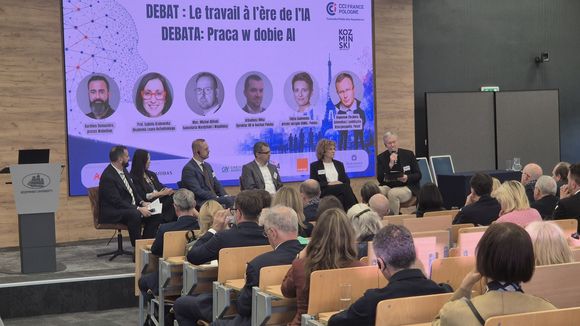
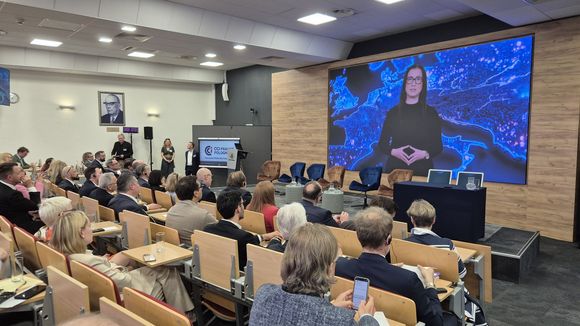
Photos: CCIFP.
The panel included Bogusław Chrabota, Aurélien Deleusière, Professor Izabela Grabowska, Michał Gliński, Arkadiusz Mika, and Edyta Sadowska.
European Employment Services (EURES) Return Mobility program
Since 2019, Professor Izabela Grabowska has conducted a research-based educational and social-impact program on return mobility for European Public Employment Services and the EURES network. The program has been developed and delivered in cooperation with EY and European Union institutions, including the European Commission and the European Labour Authority.
The program translates research on return migration, labour-market reintegration, skills, human capital, and social remittances into practical training for EURES advisers and representatives of Public Employment Services. Between September 2019 and February 2026, the program comprised 13 editions, as well as a special webinar devoted to return mobility during the COVID-19 pandemic.
Editions:
- 13th edition: Return Mobility
10-12 February 2026, Warsaw, Poland.
Programme for EURES and European Public Employment Services. - 12th edition: Return Mobility
7-10 October 2025, Warsaw, Poland.
Programme for EURES and European Public Employment Services. - 11th edition: Return Mobility
27-29 May 2025, Bologna, Italy.
Programme for EURES and European Public Employment Services. - 10th edition: Return Mobility
24-26 September 2024.
Programme for EURES and European Public Employment Services. - 9th edition: Return Mobility
27-29 February 2024.
Programme for EURES and European Public Employment Services. - 8th edition: Return Mobility
12-14 September 2023.
Programme for EURES and European Public Employment Services. - 7th edition: Return Mobility
13-15 September 2022.
Programme for EURES and European Public Employment Services. - 6th edition: Return Mobility
22-24 February 2022.
Remote classroom program for EURES and European Public Employment Services. - 5th edition: Return Mobility
16-18 February 2021.
Remote classroom program for EURES and European Public Employment Services. - 4th edition: Return Mobility and the Pandemic
17-19 November 2020.
Remote classroom program for EURES and European Public Employment Services. - 3rd edition: Return Mobility
28 September-1 October 2020.
Remote classroom program for EURES and European Public Employment Services. - 2nd edition: Return Mobility
3-5 March 2020, Prague, Czech Republic. - 1st edition: Return Mobility
24-26 September 2019, Budapest, Hungary.
Special webinar
Return Mobility and the Pandemic
28 April 2020, online.
Organised by EY for EURES and European Public Employment Services.2nd edition, Return mobility, 3-5 March 2020, Prague, agenda.
Webinar, Return mobility and pandemic, the 28th of April 2020, EY for PES and EURES.


Beyond the EURES Return Mobility programme, Prof. Izabela Grabowska’s social-impact activities include the following:
1. My Migration research and self-assessment portal
Prof. Grabowska initiated the My Migration portal as part of the BigMig research programme. It enables people with migration experience to complete a research-based questionnaire and receive free, automatically generated feedback about their psychosocial resources, competences, and labour-market potential. This is a direct example of translating migration research into an accessible tool for individuals, career advisers, and institutions.
2. Warsaw Talent Cluster
She leads the Warsaw Talent Cluster, developed jointly by the CRASH Centre at Kozminski University and the Strategy and Analysis Office of the City of Warsaw. The initiative examines the situation of highly qualified international residents using LinkedIn data, focus groups, and results from the My Migration portal. Its purpose is to support evidence-based urban policies concerning talent attraction, retention, integration, and the Warsaw labour market.
3. Link4Skills policy engagement
As Scientific Coordinator of the Horizon Europe Link4Skills project, Prof. Grabowska contributes to policy-oriented work on skill shortages, migration, reskilling, demographic change, AI, and automation. The project produces policy briefs and practical tools intended to help public authorities, employers, employment services, educational institutions, and civil-society organisations respond to labour-market shortages and improve migrant skill recognition.
4. Link4Skills Navigator and migration-skill corridors
An important strand of this work is the development of the Link4Skills Navigator, conceived as an evidence-based instrument for analysing labour shortages, available skills, migration pathways, and support programmes. The intended social impact is to improve coordination between research, migration policy, employment policy, and workforce planning.
5. EUonAIR mobility and AI tools
Prof. Grabowska is a co-creator and first principal investigator of the European University Alliance EUonAIR: AI in Curricula, Smart UniverCity and (Return) Mobility. Its social-impact dimension includes the development of AI-supported educational approaches, responsible academic mobility, institutional cooperation, and the My Mobility assessment dashboard, designed to help students and universities reflect on the value and outcomes of international mobility.
6. Research-based support for migrant and refugee integration
As leader of the Polish team in the Horizon 2020 MIMY project, Prof. Grabowska worked on the integration and empowerment of young migrants living in vulnerable conditions. The project combined research with engagement involving migrants, local stakeholders, practitioners, and institutions, with the aim of making integration policies more responsive to migrants’ lived experiences and capacities.
7. Public debate and knowledge dissemination
She regularly participates in public debates, media interviews, podcasts, public lectures, and expert panels concerning migration, return mobility, labour shortages, refugees, skills, demographic change, and artificial intelligence. These activities translate academic findings into language accessible to policymakers, employers, journalists, students, and the wider public. Her public-facing work includes debates on the AI revolution in the labour market and lectures on migration, skills, mobility, and social change.
8. Advisory work for European institutions
Prof. Grabowska has served as a national expert for European Commission initiatives, including ESCO, the European Mobility Partnership, and, more recently, advisory and educational activities for the European Labour Authority and EURES. This work supports the application of academic knowledge in European employment, mobility, skill classification, and labour-market policies.
9. CRASH Centre as a research-to-society platform
As founder and director of the CRASH Centre for Research on Social Change and Human Mobility, she has created an institutional platform connecting researchers with cities, public institutions, migrant communities, employers, international organisations, and policymakers. CRASH addresses migration, work, social change, globalisation, new technologies, and economic transformation through interdisciplinary and applied research.
10. Social-remittance and return-migration knowledge programmes
Her long-term research programmes on return migration and social remittances have been designed not only to produce academic publications but also to build knowledge resources for policymakers and practitioners. They examine how migrants transfer competences, values, practices, and social innovations between countries and how these resources can support local communities, workplaces, and institutions.